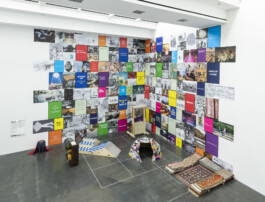
Kunsthalle Düsseldorf, photos: Katja Illner
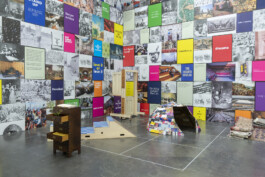
Junkology is a work of interactive sculpture and performance by Fari Shams and the performance group Every house has a door.
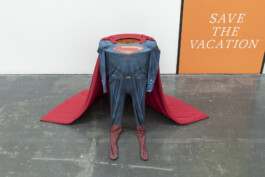
The installation takes the form of a game: a spiral grid of nine squares becomes a stage for eight sculptural “game pieces” created by Shams from found furniture parts, domestic objects, and everyday materials. Over the course of the exhibition, visitors are invited to rearrange these objects, continually reconfiguring the work.
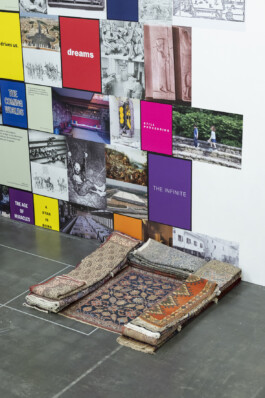
On the surrounding walls, Shams presents a constellation of texts and images that trace a social history of public and private space—through architecture, festivals, ceremonies, marketplaces, playgrounds, industrial towns, garden cities, and data centres. Political, philosophical, poetic, and pedagogical in tone, these interventions extend the work’s scope from the material to the conceptual.
Junkology revisits the history of progressive education in the late nineteenth and early twentieth century Europe, which viewed learning as an active, physical, and social process. It draws inspiration from the post war “adventure” or “junk” playgrounds, where unstructured construction and collective imagination shaped the environment. This ethos—learning through doing—runs throughout the work.
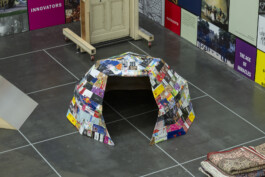
A hand block-printed fabric dyed with pomegranate and beetroot drapes across a korsi table used in the performance. The “human nest,” a geodesic dome covered with recycled consumer packaging, transforms excess into shelter—a quiet space for reflection, built with the same care and instinct as a bird shaping its nest.
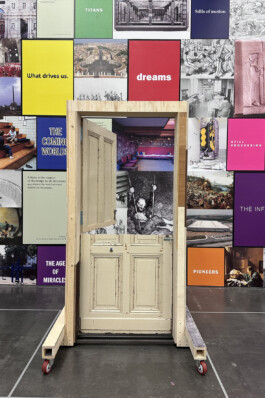
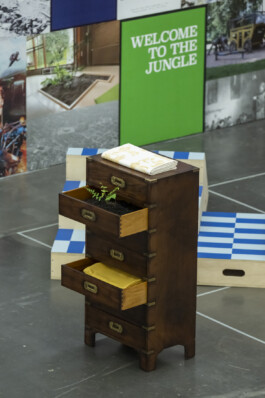
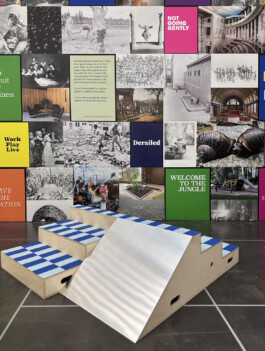
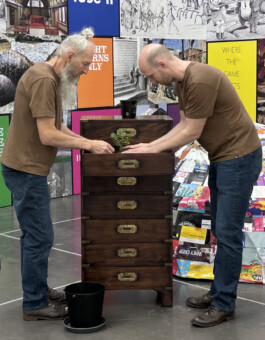
A “Dutch door,” made in homage to architect Herman Hertzberger, is constructed from scrap wood and placed on wheels to transform any threshold into a space for conversation. A staircase, also referencing Hertzberger’s designs, highlights his belief in architecture as a framework for collective activity and exchange. A chest of drawers housing a living fern points to the artist’s ongoing exploration of systems of classification, where life continually resists containment.
Together, these elements invite reflection on the spaces that make us feel at home—and those that enable connection with others. Junkology asks whether maintaining and reimagining the communal structures that sustain creativity might also resist the processes of deskilling that increasingly shape our cities.
The performance that inaugurated the work by Every house has a door unfolded as a game of chance led by two choreographed stagehands, Bryan and Jake Saner—a father-and-son team. Audience members drew numbers to determine the order of the game pieces’ placement, each act transforming the board anew. Four textual interruptions punctuated the sequence—read first in English by Matthew Goulish, then in German by one of three participating children. With this, the game was opened for public use.